Intercultural Trainers Kit for Migrants’ Educators Promoting interculturality, tolerance and diversity in the learning process: In this section you will find a collection of more than 35 good practices which provide successful methods and approaches towards work in a multicultural environment, promoting tolerance, diversity and inclusion in the learning process, application of intercultural teaching resources, raising the participation and attainment of adult migrants in the educational process, etc. The good practices aim at improving the intercultural skills of migrant educators and at helping them include new approaches towards work in a multicultural environment in the teaching process.
The Vocational Guidance in CLIL (Content and Language Integrated Learning) for migrants platform will be specifically designed for migrants living in one of the 5 partner countries, regardless of their status, with a basic command of the host country language (levels A1, A2 and B1). The platform will display different modules, each one composed of thematic units, corresponding to specific activities. Exercises will be designed with a visual approach, using images, videos and short sentences, rather than long texts, and they will address topics related to social and cultural inclusion as well as labour market and work culture such as job offers (where to find them), how to apply for a job, work legislation, social manners, public holidays, recognition of skills, schools and nurseries, public transports. Finally, an encouraging and interactive interface will be developed to reward users for correct answers and good performances.
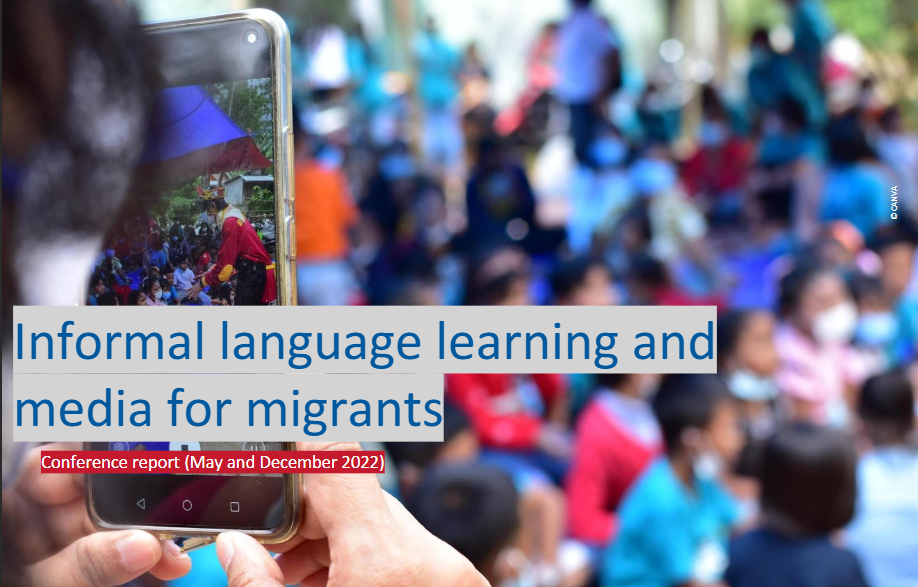
The UNESCO Informal language learning and media for migrants Conference report (May and December 2022). The main objectives of the conference were: To raise awareness and promote the exchange of innovative ideas and solutions on informal language learning for migrants in the Nordic countries. To highlight the value of informal language learning for the integration of migrants and identify ways in which formal and informal language learning can enrich learners’ experiences. To highlight best practices to expand networks and partnerships within and beyond the Nordic countries. To emphasize the critical role of the Nordic mass media in promoting language learning as an integral part of a democratic society.

Within the project “Meet the Need. Vocational Teaching Material Supporting the Integration of Migrants into the Labour Market” (developed 2011-2012 under the Lifelong Learning / Grundtvig programme) vocation related material for second language classes was developed in close cooperation with vocation experts and language teachers. This teaching material supports language teachers in preparing migrants for the requirements in the occupational fields of retail trade, care, food services, office communication and construction. On the project website you can still find material in 5 languages (German, Danish, English, Italian and Romanian): Adaptable exercises, Teachers’ tips, answer tables & transcripts, Audio material, Picture material.
The project GAME ON – Language Learning Games for Migrants and Refugees is a co-funded Erasmus+ project which proposes an innovative, non-formal learning game-based approach, promoting social inclusion of migrants and refugees through foreign language learning, focusing on everyday dialogues that adult people need in their usual social interactions.

The Guidebook “Learning Zone – new approaches to language courses for migrants and refugees” is developed on 6 chapters, associated with 6 training modules. Each chapter opens with the learning objectives and ends with questions for reflection. The Guidebook concludes with a short glossary of terms along with a bibliography. It is conceived in a way that enables facilitators to integrate new ideas into their current practice with migrants and it also gives access to other materials available for further learning. Also, at the end of the Guidebook, several practical exercises can be found that can be used in the classroom.
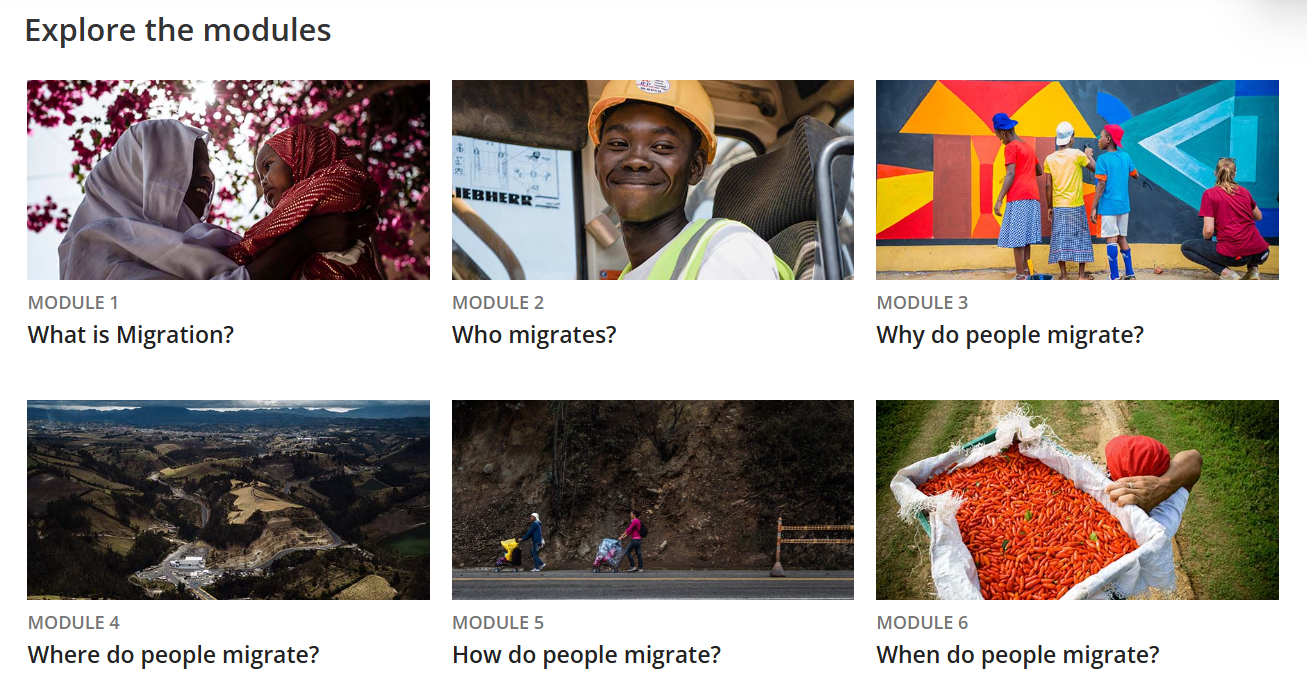
The World Migration Interactive Educators’ Toolkit is a set of resources for educators to teach about migration, migrants and human geography. It draws upon the extensive research and analysis in the World Migration Report series to deliver specialized tools and resources.
This literacy and second language acquisition for the linguistic integration of adult migrants (LASLLIAM) reference guide, funded and supported by the Education Policy Division at the Council of Europe, is the outcome of four years of work. Its development was characterised by a continuous process of production, feedback collection and revision. As part of this process, the authoring group collected valuable feedback from two rounds of consultation with experts from the Council of Europe. It also greatly profited from considering advice and suggestions from colleagues, researchers, teachers, language testers, academic institutions and associations. Once the structure, themes and topics of the reference guide were drafted, a qualitative validation followed by a quantitative validation on descriptors and scaling took place, involving in total 831 participants, 31 languages and 28 countries. Statistical analysis, conducted by CITO, contributed to the validation of the scales/descriptors in their English version.
This document presents the catalogue of initiatives prepared for the 2021 update of the MOOCs4Inclusion study, financed by the Joint Research Centre (JRC) of the European Commission. This third study is coordinated by Dr Charalambos Vrasidas and the CARDET team. The information provided online (www.moocs4inclusion.org) describes free digital learning (FDL) initiatives. This version, developed as part of the third study, updated on 24/09/2021 contains two types of initiatives: Initiatives identified in 2019 that were updated and validated by their providers, as well as new initiatives identified in 2021 (Updated and Validated Initiatives). Initiatives which have not been updated or validated but whose links and contact information continue to function (Functioning Initiatives). FDL initiatives listed in this Catalogue vary quite a bit in nature and magnitude. However, attempts have been made to categorise them according to ‘purpose’, the type of resource or technology they use, whether they are ‘blended’ approaches or only online/digital, and the extent to which they are ongoing or forthcoming (awaiting launch), and whether they provide information regarding the basic Europass specifications (title, organisation, location, thematic area, learning outcomes). These labels will be further described in the next section. Some fields have been left blank due to lack of public information. This version of the Catalogue includes the list of additional resources relevant for migrant and refugee digital education identified in the previous study which are still functioning, as well as one new resource.

Be part of the world’s largest online English teaching community. Teaching English is a global program for English teachers and teacher educators, drawing on UK and local expertise, and the unique insight and experience of the British Council. Build your professional network, share ideas and knowhow, and stay up to date with the latest research and innovations in teaching. You’ll find lesson plans, events and learning resources to support your practice, as well as new opportunities to help your career grow – whether you’re taking your first steps as an English language teacher, or your next steps as a teacher educator. We have a wide variety of books, self-access guides and resource books for you to download in pdf format. We also have several practical activity books full of ideas and photocopiable material for you to use in the English language teaching classroom and teacher training room.