You will find in this Chapter:
Lexicon-focused
Topic-focused
Spoken language focused
Culture-focused
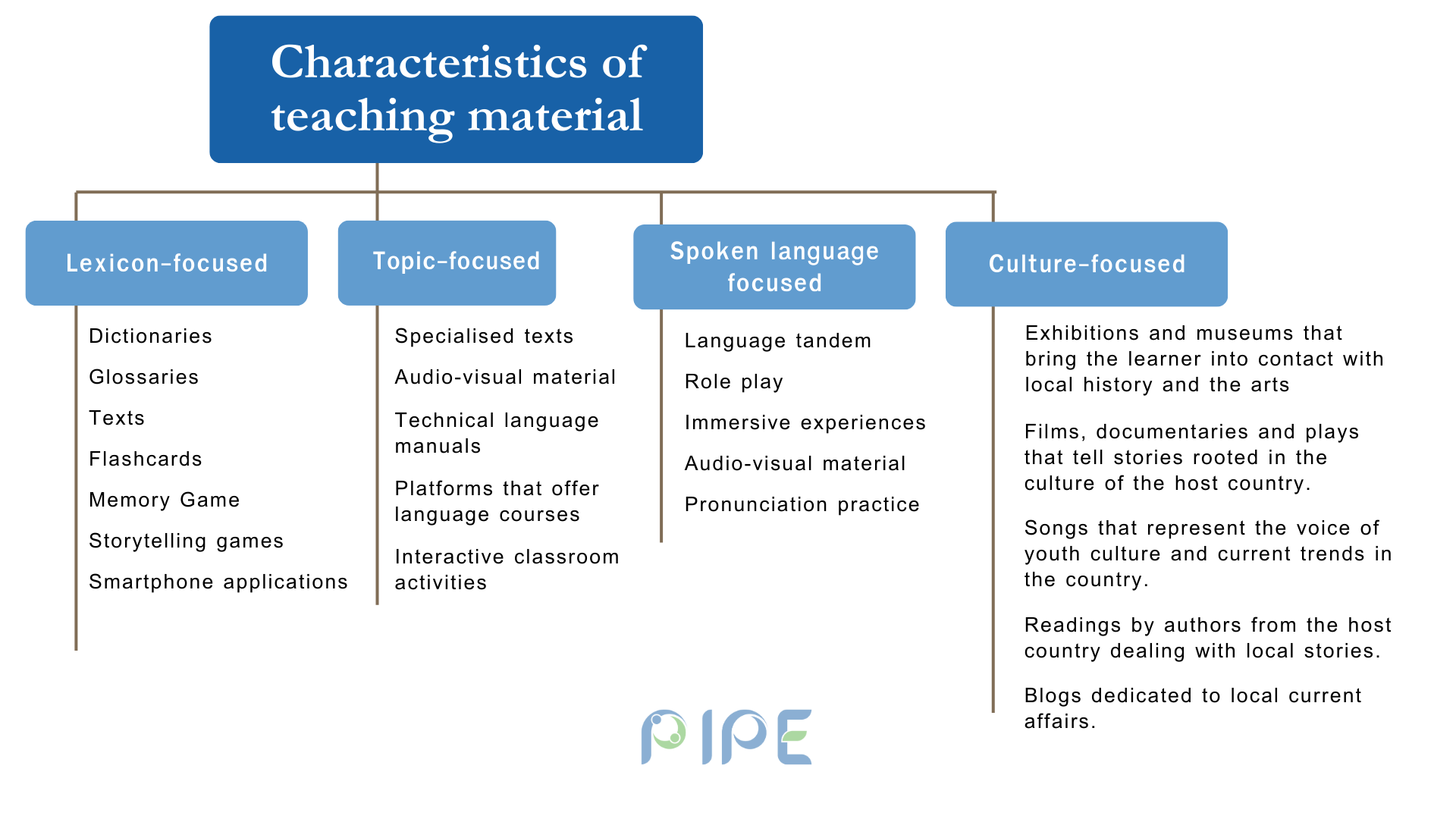
In light of the above, the language teaching material for a course aimed at migrant learners should meet the following characteristics:
- Be suitable for the language skills demonstrated by the learners in the cognitive questionnaire.
- Demonstrate cultural sensitivity and variety, to respect diversity and avoid stereotypes, prejudices and potentially offensive situations.
- Motivate, engage, stimulate learning.
- Describe authentic and practical real-life contexts that lead learners to develop effective communication skills. Commercials, films, TV series, songs, newspaper articles and novels are excellent materials that enable them to establish a concrete relationship with the cultural context of the host country.
Finally, the learner should be encouraged to learn independently by apps, online materials and grammar manuals designed for self-study that are adaptable to needs and accessible regardless of any disabilities.
Lexicon-focused
Here are some examples of teaching materials focused on vocabulary learning:
- Dictionaries: printed, online, bilingual or monolingual.
- Glossaries: collections of words referring to a specific topic. They can be inserted at the end of individual units, so that the learner can build up their vocabulary base on specific contexts.
- Texts: novels, comics, song lyrics, newspaper articles, poems, blogs, website pages. They offer the learner contact with living language applied to its most natural purpose, that of narration and communication. It is important to select texts that are appropriate to the learners’ level of language competence. For example, one could opt for graded readings, such as those proposed by the Black Cat Cideb publishing house
- Flashcards: cards with the foreign word on one side and the translation into the mother tongue or a lingua franca, such as English, on the other. For an advanced version, you can replace the translation with a description of the word in the foreign language. Flashcards are easy to obtain or create yourself. They can be used in class for group activities or for personal review sessions.
- Memory Game: and other matching activities such as ‘complete sentences’ exercises, word games and crosswords are interactive and fun activities that help develop short-term memory and the ability to associate words with their meanings.
- Storytelling games: an activity like role-playing in which pupils take turns in inventing a common story. It can be supported by a deck of ‘cue’ cards that provide the participants with ideas. Adaptable to all levels of language proficiency. Rory’s Story Cubes games allow participants to invent stories from a simple throw of dice.
- Smartphone applications: promote vocabulary learning through gamification. For example, the Memrise application. A smartphone is one of the most important tools for a refugee. Here are some useful smartphone apps.
Topic-focused
Subject-oriented material includes:
- Specialised texts and audio-visual material: specialised dictionaries, glossaries, newspaper articles, essays, manuals, interviews, lectures, demonstration videos, podcasts, specialised blogs, thematic forums and websites.
- Technical language manuals: suitable for learners who need to go in-depth into the language of a particular field, such as journalism, film, business, marketing, law or medicine.
- Platforms that offer language courses for specific purposes are available online (for a fee), such as Udemy
- Interactive classroom activities: presentations of group projects, teacher-led debates, simulation of contexts through role-play.
Spoken language focused
Offering the student a linguistic preparation oriented towards oral communication means allowing them to develop the ability to understand and fluently produce speeches in the foreign language, and thus to go beyond the simple memorisation of words and grammatical rules. It means, in other words, giving them the tools to experience the language as a tool for social integration, reducing the gap that separates them from the culture of the host country.
Here are some examples of strategies that can be put into practice to facilitate the learner’s approach to the spoken language:
- Language tandem: the learner converses with a native speaker or another learner at a higher level.
- Role play: recreating real communication situations in the classroom (visits to the shopping centre, shopping in the shop, negotiations, presentations, interviews, etc.).
- Immersive experiences: e.g. the use of virtual reality (VR) to recreate real conversation scenarios that are more concrete than simple role-playing between learners (doctor’s visits, job interviews, ordering at restaurants, etc.).
- Audio-visual material: films, TV series, YouTube channels and current podcasts, enjoyed where possible with subtitles in the foreign language, representing a real picture of everyday speech. Unfiltered forms of speech enable familiarity with colloquial language.
- Pronunciation practice: using the teacher’s guide or an app to familiarise you with the sounds of the host language.
Culture-focused
Language is closely related to the culture of the country in which it is spoken. To deepen the socio-cultural context within the units of a course for migrant pupils, it may be useful to make use of the following materials and activities:
- Exhibitions and museums that bring the learner into contact with local history and the arts.
- Films, documentaries and plays that tell stories rooted in the culture of the host country.
- Songs that represent the voice of youth culture and current trends in the country.
- Readings by authors from the host country dealing with local stories.
- Blogs dedicated to local current affairs.