Bubble question
What travels in that silence?
Listening to this Berber story, that the anthropologist Marc Laberge rescued, recalling the sensation of abyssal immensity that Pascal felt when he understood the immensity of the universe, we ask ourselves what is in the silence of the protagonist of the story, in her memory and what the mouse that frees her symbolises. Before setting out to think about how to teach the national language to a migrant person, we must ask ourselves how we are going to relate to them. As in the story, what is in his own language, in his memory, surely there is room for much more than in the suitcase in which he had to abstract all his past. Thousands of years seep into a culture that lodges in the person who, feeling like a foreign body, comes to sit in front of us after an odyssey that has only just begun. As Stendhal said in Red and Black, in every life there is a novel that deserves to be written. Behind the gaze of that person who does not understand us and whom we do not understand, there is a story with which to build a migrant citizenship capable of participating, as a guest, in the commons, in the community, by connecting and committing. Are we going to discover that story? Are we going to listen to it? Positioning ourselves from a pedagogy of hospitality invites us to ask ourselves what travels in this gaze that cannot be expressed, for the moment, with new words.
We are in the planetary era and human beings, wherever they are, are embarked on a common adventure. They need to recognise each other in their common humanity and, at the same time, recognise the cultural diversity inherent in all that is human. (Morin, 2015, p. 63)
How does the migrant feel when he/she arrives in a place he/she does not know and of which he/she does not know the language? We should ask this question before we consider teaching the national language to a migrant. Start by listening to their story. Their migrant narrative contains a culture, a context, and an experience that are the source of their dignity. Behind their words, in their mother tongue, lie hundreds or thousands of years, these sounds that we do not understand are the tip of the iceberg of invaluable knowledge that can either be silenced or we can choose to dialogue with them. This initial reflection positions us in relation to the person who needs to learn our national language and makes us think about what we are going to teach it for, and then how.
Within the perspective of critical pedagogies, the educational relationship established in the teaching of a national language to a migrant person must be approached from a problematic, dialogical stance, so that acquiring the new language does not mean losing or abandoning one’s own language, nor does it mean assimilating without questioning the culture or cultures that live behind the language that will host us in the new country. It is complex to counteract the technical tendencies, based on grammar, and the useful content required by the labour market. Educating through the teaching of a language means playing a leading role in a pedagogy of hospitality and interaction, not a mere transactional relationship.
Pedagogy imagines education as the art of overcoming phobias with philias. Understanding the relationship between curiosity and danger leads us to ask why we call our home Earth when it should be called Ocean. Three parts of this planet are water, and the same proportion is in our own body. More important than the wheel was the discovery of swimming and navigation. Thanks to these discoveries we broke the limits set by our own genetics. We were not born to swim, as if our destiny was to remain on land. We didn’t stay on land, we took the plunge out of curiosity, because it is in our nature to learn to overcome our fears. At least a hundred thousand years ago the Neanderthals of the Grotta dei Moscerini dived to depths of five metres to collect clams. Swimming and then sailing allowed us to get to know the world and to recognise each other. From the sharing of dangers arose the laws of hospitality, from shared passions compassion was born. The first liquid law, Xenia.
I knew that no matter what door you knock on in a Cretan village, it will be opened for you. A meal will be served in your honour, and you will sleep between the best sheets in the house. In Crete, the stranger is still the unknown god. Before him, all doors and all hearts are opened. (Kazantzakis)
Hospitality or a feeling of welcome among peoples who shared the fear of shipwreck, that ancestral putting oneself in the place of the other that is reflected in the Odyssey or in Homer’s Iliad. A custom shared by all the cultures that live in the memory of the place we call Europe, and which, without the same borders, has become a ‘democratic’ community due to migratory movements and the influence of a myriad of cultures. Hospitality they called Xenia, a bond of hospitality, friendship between guests. Its etymology derives from the noun xénos which means foreigner, guest. In other words, xenophobia does not only mean hatred of the foreigner, it is also an antagonistic position towards hospitality. Xenia was so important that, even though it was not institutionally regularised, it was recorded in a ritual with a series of clearly differentiated steps that are reflected in the following songs of the Odyssey: first the welcome; the roof and the food, second the interest in the other, a kind of pedagogy of questions and a third step, the exchange of gifts as a dialogue of knowledge.
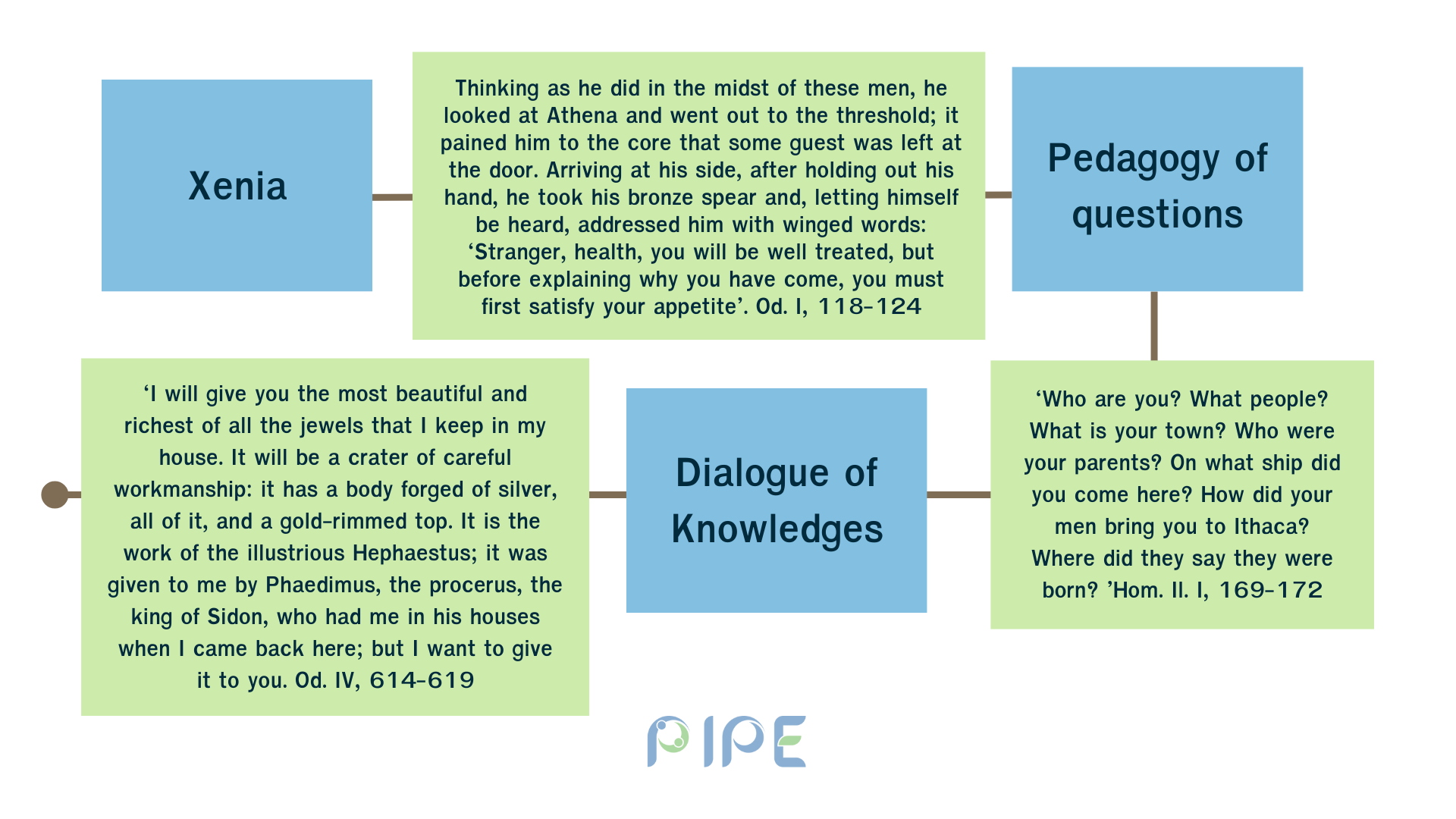
As professionals or volunteers who are going to play a leading role in hospitality by teaching the national language, we need to ask ourselves and ask questions, in the way Socrates founded his maieutic. To translate interculturally, i.e. to bring the Xenia – which founded Europe as a home for migrant cultures – into the present through a diatopic hermeneutics, so that we plan the teaching of the national language through the phases of the ritual of hospitality – as vertices of a pedagogy of hospitality-.
I call it diatopic hermeneutics, insofar as the distance to be overcome is not merely temporal, within a single, broad tradition, but is the distance that exists between human topoi, ‘places’ of understanding and self-understanding, between two (or more) cultures that have not elaborated their models of intelligibility…. Diatopic hermeneutics starts from the thematic consideration that it is necessary to understand the other without presupposing that the other has the same self-knowledge and basic knowledge as we have. The ultimate human horizon is at stake here, and not only contexts that are different from each other. (Raimon Panikkar, Mito, fe y hermenéutica, Barcelona 2007)
Xenia, from this diatopic hermeneutic, means a cultural exchange through the linguistic teaching-learning process of reception. Making the migrant feel at home requires from the professionals or volunteers an attitude of respect and curiosity towards what we point out with the first question we formulated in this chapter, what travels in the silence of those who do not understand us? What lives behind a language? And another question that underlies the one formulated and which we address in the third section of this block: what elements of our cultures are we going to convey through the teaching of the national language? Selecting content from a critical perspective entails a questioning of our society; it is not only a question of offering significant contributions from the different disciplines that make up our knowledge, but also of warning about the threats that arise from our inequalities and miseries. Offering the complexity to host and, at the same time, empower the person who arrives. To design a curriculum so that the teaching of the national language becomes an epistemology of consequences that generates knowledge as an intervention in reality, an indispensable step towards the construction of a migrant citizenship.
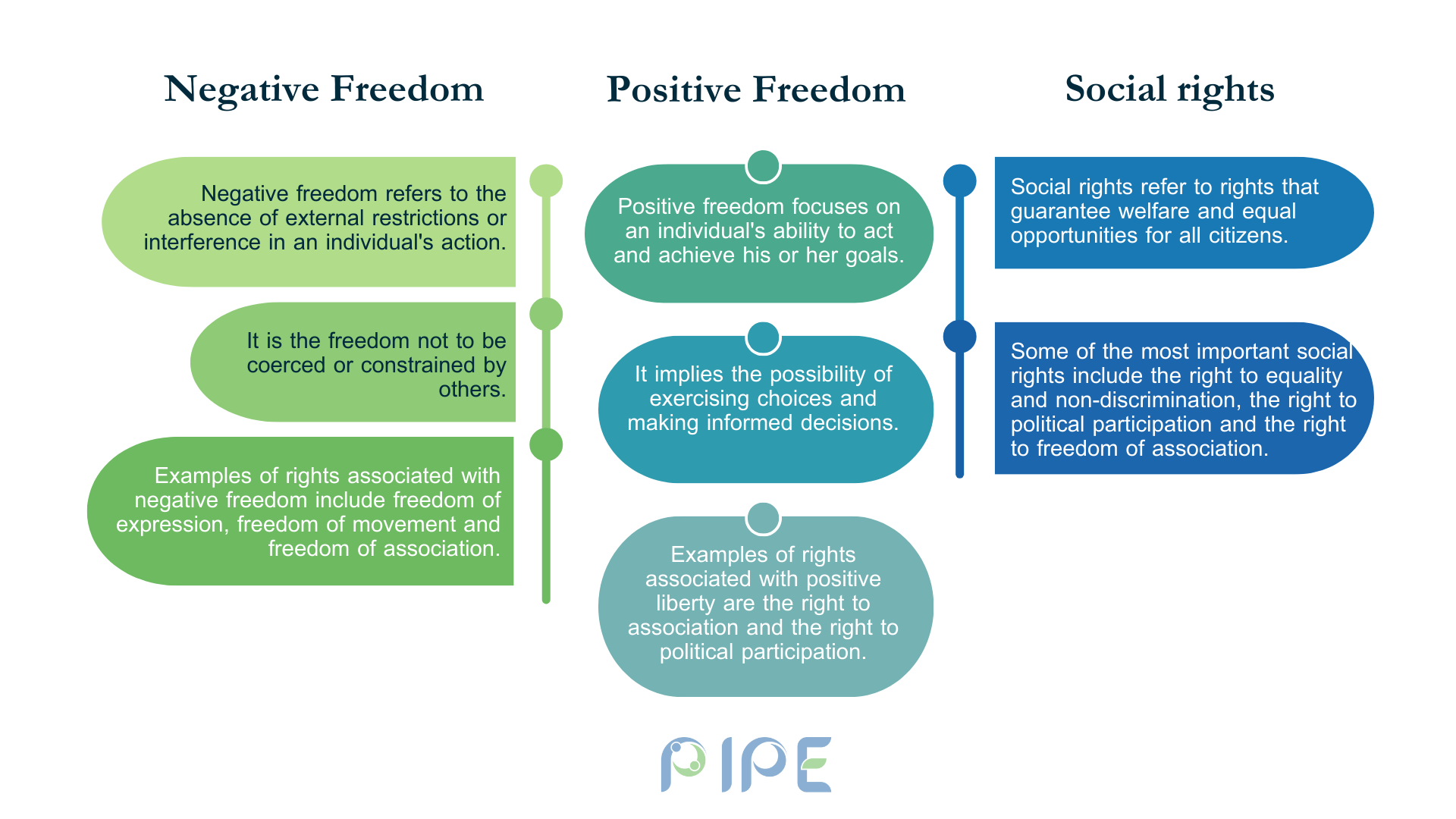
The political nature of education as a process of transformation of people for the transformation of the world requires a brief review of what is necessary – as a conditio sine qua non – for democracy, i.e. citizenship. The construct of citizenship that emerges in Greece between Homer and Socrates is configured on three points: negative freedoms that have to do with those aspects that the State must respect and protect, positive freedoms that refer to the duty of each person to participate politically in the community, in the commons, and social rights that guarantee a dignified life for all.
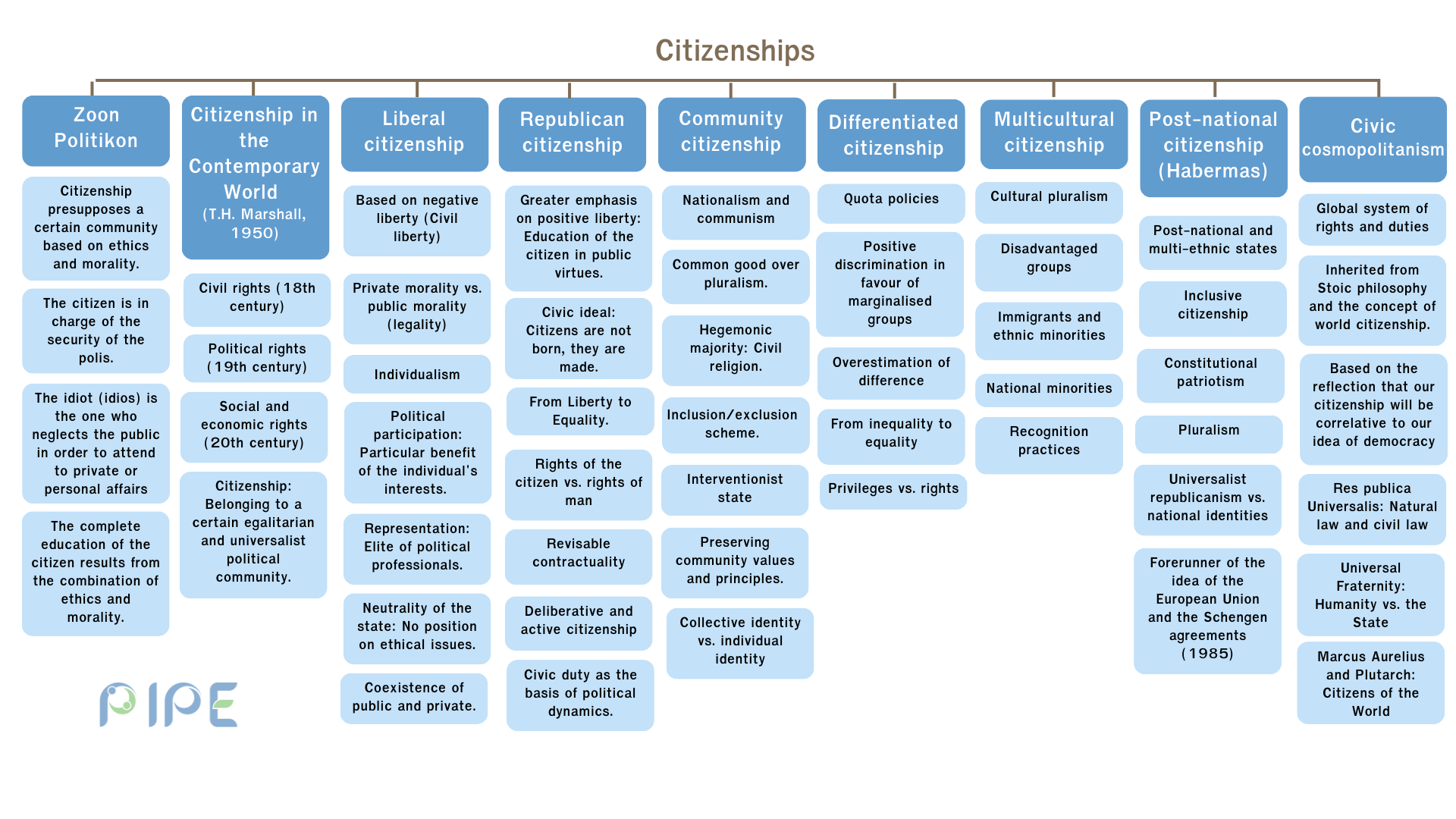
The challenge as professionals or volunteers is also to understand the evolution of the concept of citizenship from the Greek model to the liberal model of the American and French revolution, passing through the socialist proposals of community citizenship, the republican version, differentiated citizenship, multicultural and post-national citizenship that make up the European Union, in order to understand that all our versions throughout history are based on two elements that make it difficult to be welcomed as a host. The ius solis and ius sanguinis – which underpin our models of citizenship – require being born in a specific territory or being the child of parents who are from a specific territory. A migrant citizenship needs to be educated, through language teaching, to understand the elements of the host culture that hinder intercultural processes. If education, specifically the teaching-learning of the host language, does not serve to build citizenship, then it is a process of acculturation, of subjugation, of segregation, a colonisation of knowledge that does not want the newcomer to participate except as a stranger, with limited rights and duties, something like the free version of the applications that are multiplying on the Internet.
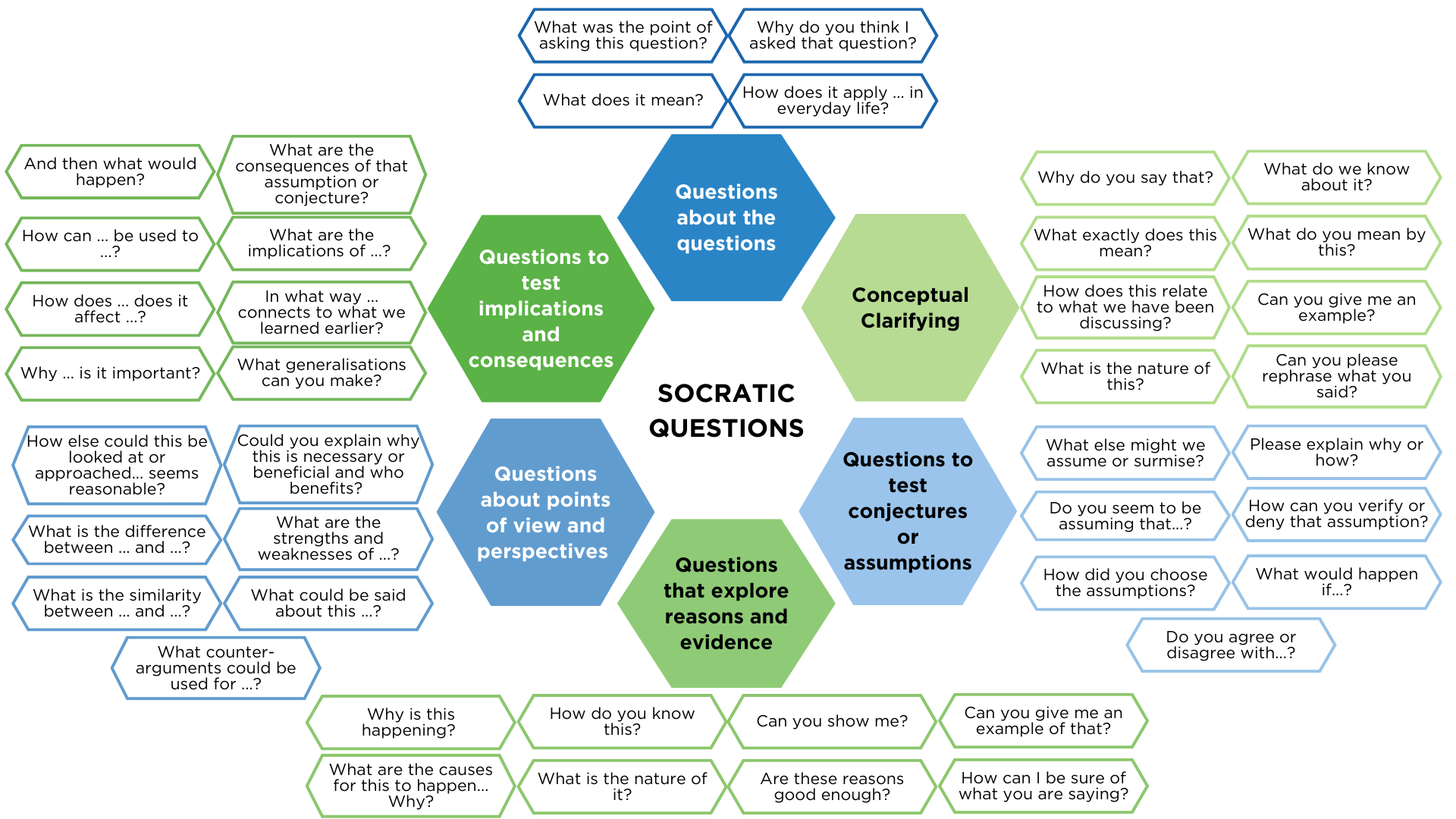
Building a migrant citizenship by educating and learning requires an ethic of miscegenation. Strong, national, impermeable identities do not mix and a pedagogy of hospitality needs to mix, which makes migrant pupils’ protagonists and participants in the teaching-learning process of the host language through their words, their memory, their experience, their culture. This is a Copernican turn of events like the one that Rousseau proposed in relation to the teacher and the child who needs, following the ritual of the Xenia, a pedagogy of questions and a dialogue of knowledge.
What do we mean by dialogue of knowledge? An environmental rationality that links us to an intercultural dialogical relationship, starting from what Enrique Leff proposed. We need to introduce elements of the pedagogy of questions from Socrates to Freire, thus generating an entrance porch, a hallway where to promote a substantial exchange of cultures through words, because we think words and teaching them also implies teaching to think of another way of inhabiting the world.
It implies a dialogical relationship of exchange, in both directions, on the part of the professional or volunteer to offer significant contents, elements of the host culture that represent it in its complexity, that offer its splendour and its contradictions, that result in a vivid portrait capable of containing the ethical and the aesthetic in balance. What contents are we talking about? It is a question of widening the narrow corridor of useful knowledge to create a space where incalculable knowledge, excluded by the techno-scientific pact that colonises knowledge, can offer hospitable epistemologies, where otherness can be recognised, feel part of it, belong. It is not up to us to decide which ones, surely, we share many of these references that make up our cultural canon, from the arts to the sciences, we can compose a curriculum that invites migrants to learn the new language as a door to the memories that tell us about sharing the world. A case in point is the vital and then written work of Nuccio Ordine (a teacher who read short texts of the classics in any subject with the intention of making students discover the particularity of their existence within those works which, the teacher sighs, he would one day read to live better and feel part of something greater than the self).
‘Let others boast of the pages they have written; I am proud of the pages I have read’, said Borges. And the fact is that good books transform us; a passage, however brief, can awaken the reader’s curiosity and encourage him or her to read a work that will change his or her life forever. That is the power of literature, which not only opens up horizons, but slowly but steadily gives us the key to understanding life. (Nuccio Ordine, Classics for life)
We skipped, in the last paragraphs, the second vertex which is a fundamental condition for the third, the dialogue of knowledge. The strategy of the inn, which is reflected in the beginnings of the Decameron and in the Canterbury Tales, typical of migrant cultures, is shaped as a pedagogy of questions. We must ask ourselves what it means to ask questions. To underline that Freire intuited curiosity in the body of a question and that knowledge seemed to him to come from the art of questioning.
The foreigner (…) begins when I become aware of my difference and ends when we all recognise ourselves as foreigners, rebels against ties and communities. And to be rebellious is to feel uncomfortable again in this world, it is to assume the dissatisfaction of the seeker, the curiosity of the questioner. It is to lose sleep over the need to decipher a text, it is to recover the passion for knowledge and, in the end, for life. (Piastro, 1998, p. 153)
To ask is to want to understand, different from understanding – as Ortega y Gasset thought -, to understand is to want to know the other person, an express desire to break down prejudices, to break down archetypes, to dismantle myths and, with the generosity of someone who feels like a guest in the world, to invite the migrant person to learn the new language from their words and their narratives through questions. What do we know about the migrant who needs to learn the language of the host country? How many writers have we read? Do we know about their representative works of art? Do we know about their beliefs or their daily lives? Do we feel we can learn from those who come to learn? What can we learn by teaching the national language of those who learn it?
(…) integrated by multiple belongings, some linked to an ethnic history and others not, some linked to religious tradition and others not, from the moment we see in ourselves, in our origins and in our trajectory, diverse confluent elements, diverse contributions, diverse crossbreeding, diverse subtle and contradictory influences, a different relationship is established with the others, and also with those of our own ‘tribe’. It is no longer simply ‘us’ and ‘them’, like two armies in order of battle preparing for the next confrontation, for the next revenge. Now, on ‘our’ side there are people with whom I ultimately have very little in common, and on ‘their’ side there are others with whom I can feel very close.. (Maalouf, 1999, p. 44)
If we don’t want to reproduce what is contained in Galeano’s poem Los Nadies, to ask ourselves questions and to ask questions is to share a place of passage and encounter, like the architecture of hospitality, to exchange cultures while learning words. And it is important because traduttore, traditore, words do not mean the same thing, they have contexts that must be narrated and listened to. Does dignified life mean the same thing here as there? Do we speak of the same thing when we pronounce the words friendship, family, wealth, happiness, fear? Each word, with each experience, is filled with unique meanings that allow for unique encounters, teaching the language to the migrant should be an event where the past is recognised in the present that hosts it. A sort of migrant narratives that promote an intercultural translation of knowledge.
The dialogue of knowledge, as the third vertex of a pedagogy of hospitality, means being cultural ambassadors of welcome, listeners, in the application of Xenia, of the migrant’s story; in other words, questioners who learn the other in order to be able to teach not mine, but ours, and also to travel through all the knowledge, the useful and the useless, so that all identities are found in the words they learn. When we ask at the beginning, ‘What travels in silence?’ we project in the professional or volunteer the seed of curiosity to understand who arrives terrified, without family ties, without knowledge of customs, symbols, rules, unprotected and vulnerable, and not to succumb to paternalism, to put ourselves in the other’s shoes without forgetting that they are not ours in order to promote an education linked to this model of migrant citizenship that allows them to know their rights, their duties and commit themselves to participate in the common, in the community. As Aristotle stated, the common, the koinos, is produced when citizens deliberate together to determine what is good for the community, what is right to do, living together does not mean grazing together, nor does it mean putting everything in common, but rather putting words and thoughts in common, it means producing, through deliberation, similar customs and rules of coexistence that apply to all those who inhabit this tiny blue marble floating in the ether. Can we imagine teaching the national language to a migrant person in terms of the common?
Let us recapitulate: starting from that liquid law that founded the ritual of hospitality; Xenia, we need a pedagogy of questions that invites us to a dialogue of knowledge with the express will to establish, in the processes of teaching and learning the host language by migrants, an ethics of miscegenation that builds models of migrant citizenship and, for this we need what Jacques Rancière argued, that the political imagination is a possibility of the world that questions the evidence of the given reality, an imagination that favours emancipatory powers by allowing us to think and feel other coordinates beyond the logics of domination.
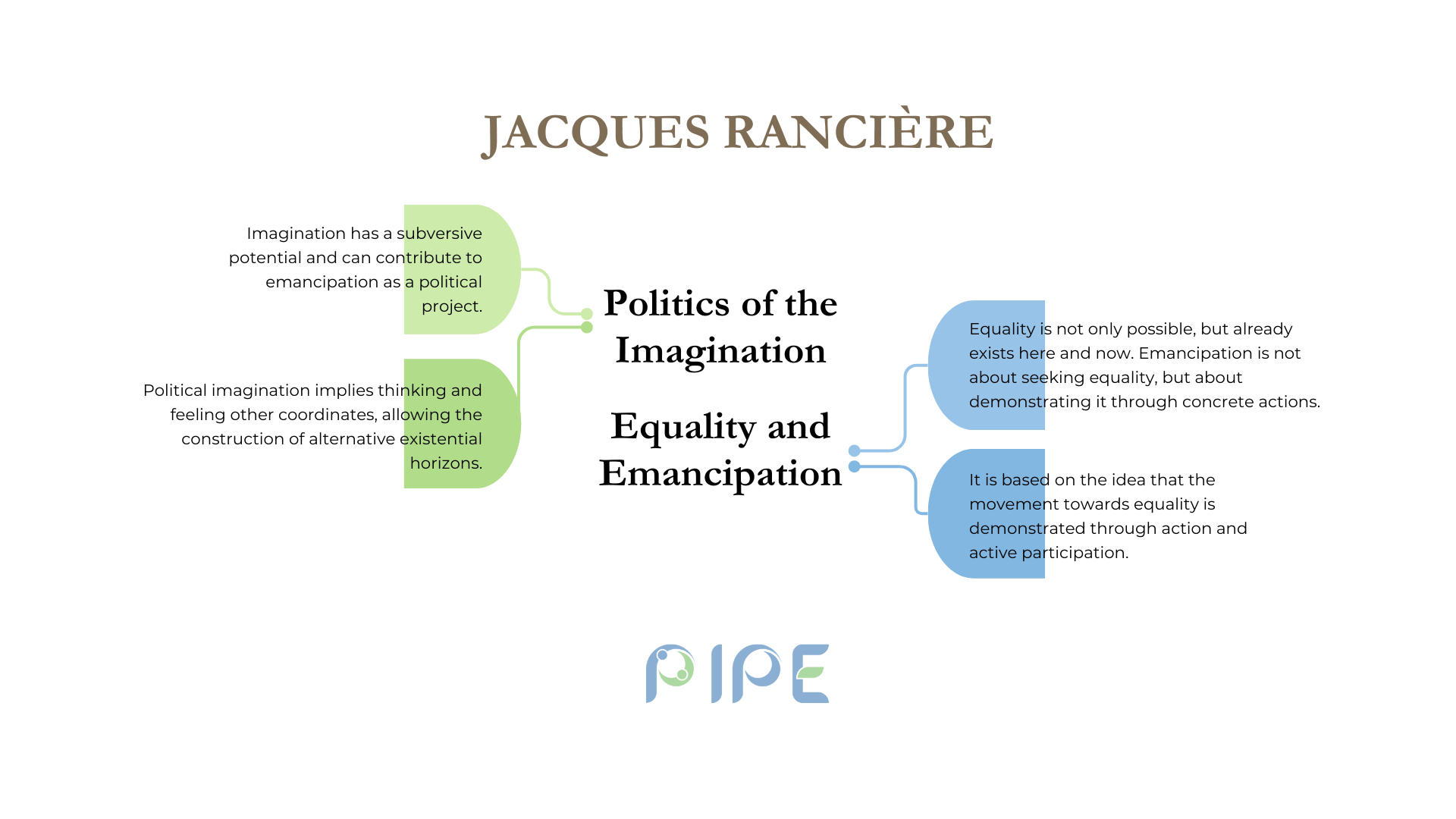
Emancipatory political imagination is a concept that refers to the ability to imagine and conceive of a world different from the present one, one that challenges power structures and seeks the liberation of oppressed people. This idea suggests that imagination is not only creative, but also political, as it can challenge established norms and open space for new possibilities. In other words, political imagination allows us to think beyond the limits imposed by general theories and universal ideas and invites us to consider transformative alternatives for society. By imagining an emancipated world, we can transcend constraints and work towards a more hopeful and liberating existential horizon.
An emancipatory political imaginary that we cannot conceive, no longer or with great difficulty, from a narcissistic, in our case Eurocentric or Westernist, point of view. We therefore need to learn to ask hard questions such as: why are there so many different principles on human dignity and social justice, all supposedly unique, but often contradictory, or what degree of coherence should be demanded between the principles, whatever they may be, and the practices that take place in their name? Or is the process of secularisation, considered one of the most distinctive achievements of Western modernity, irreversible? What, if anything, could religion contribute to social emancipation? Or is the conception of nature as separate from society, so embedded in Western thinking, sustainable in the long run? Or is there room for utopia in our world? (De Sousa Santos, Beyond the Eurocentric political imagination and critical theory) Questions that involve us beyond our particularities, whatever they may be, that summon us to play a leading role in the process of teaching a language, to play a leading role in a dialogue of knowledge where we need to break with the role of teacher-host and embody the spirit of the guest who inhabits it, for example, in Italo Calvino’s Castle of Crossed Destinies, where in a common space there is an exchange of rationalities and emotionalities, of migratory narratives that rewrite with many hands and many voices a present with the intention of a future.
Nuria Peña narrates in her podcast El Gabinete de las Curiosidades, in the chapter entitled La canica que pudo cambiar el mundo (The marble that could change the world) about a concept called change of perspective. She says that the astronauts who saw our common home for the first time contemplated a fragile blue marble floating in the ether and felt that all the conflicts we face on a daily basis, all those apparent differences of language, skin, culture, are made invisible by the perspective that this marble is the only home in which we can live in the present and imagine a future. A limited and fragile space that needs our care. To think of education of any kind without this change of perspective only seems to feed what we understand as suicidal capitalism.
Our planet is a lonely speck in the great enveloping cosmic gloom. In our darkness – in all this vastness – there is not a hint of help coming from anywhere else to save us from ourselves. Earth is the only world known so far to harbour life. There is nowhere else, at least in the foreseeable future, to which our species could migrate. Visit, yes. Settle, not yet. Like it or not, for the moment Earth is where we have to stay. It has been said that astronomy is humbling and character-building. Perhaps there is no better demonstration of human hubris than this distant image of our tiny world. For me, it underlines our responsibility to treat each other more kindly and to preserve and cherish the pale blue dot, the only home we have ever known. (Carl Sagan, A Pale Blue Dot)
The challenge to build migrant citizenships that are neither ascribed to nor contained by physical and cultural borders requires learning a critical language that dialogues and problematises the realities that are in transit, from an intercultural translation of those words that summon us towards an ecology of knowledge. A pedagogy of hospitality underpinned by an ethics of miscegenation and an emancipatory politics imagines migrants as potential friends, not potential enemies, willing and available to participate with intersubjective responsibility and to engage in the care of what Carl Sagan fondly called the Pale Blue Dot. A change of perspective to exchange the good life or capitalist binge for the art of good living, or better still, good coexistence.