This Language Sustainability Toolkit was created as a collaborative project between Living Tongues Institute for Endangered Languages and Wikitongues. Living Tongues Institute is one of the world’s leading research organizations focused on documenting endangered languages. The Institute conducts linguistic fieldwork, releases scientific papers, runs digital training workshops to empower language activists, and collaborates with speakers to create online language learning and preservation tools such as Talking Dictionaries. Wikitongues is a global volunteer movement that expands access to language revitalization. The organization helps speakers document and promote their languages online, safeguarding them for the next generation. Contributors to Wikitongues record and caption oral histories in video, raise awareness about language sustainability in their communities, and help support special projects.
Learning for Sustainability (or Education for Sustainable Development, as it is more commonly referred to outside of Scotland) empowers learners with knowledge, skills, values and attitudes to make informed decisions and make responsible actions for environmental integrity, economic viability and a just society.

The Greening Education Partnership is a global initiative that takes a whole-of-system approach to support countries to tackle the climate crisis by harnessing the critical role of education. As a collaborative platform for governments and other stakeholders including inter-governmental organizations, civil society, youth, academia, and private sector, Greening Education Partnership aims to deliver strong, coordinated and comprehensive action that will prepare every learner to acquire the knowledge, skills, values, and attitudes to tackle climate change and to promote sustainable development.
The ESD for 2030 roadmap sets out the urgent challenges facing the planet and underlines the implementation of the Education for Sustainable Development: Towards achieving the SDGs (ESD for 2030) framework, which aims to increase education’s role in building a more just and sustainable world. To complement the ESD for 2030 roadmap, this toolbox provides selected resources that support Member States, regional and global stakeholders in developing activities. Through five priority action areas and under six key areas of implementation, ESD supports the achievement of the SDGs and addresses the urgent sustainability challenges of the 21st century.
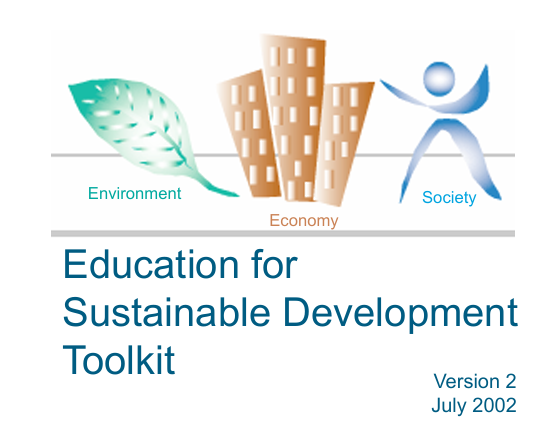
The Education for Sustainable Development Toolkit is based on the idea that communities and educational systems within communities need to dovetail their sustainability efforts. As communities develop sustainability goals, local educational systems can modify existing curriculums to reinforce those goals. As we developed the Toolkit, it became apparent that many communities have not developed sustainability goals or action plans on which to base educational change. As a result, we include some exercises to help communities develop such goals. We also include a few exercises to explain the concept of sustainable development. I was inspired to develop the ESD Toolkit after attending the United Nations (UN) Commission on Sustainable Development (CSD) in 1998. Each year, the CSD reviews several chapters of Agenda 21 from the Earth Summit (Rio de Janeiro, 1992). When I attended this meeting, the CSD reviewed Chapter 36, “Promoting Education, Public Awareness, and Training.” Through the meeting, delegation after delegation affirmed the importance of education in achieving sustainable development. Nevertheless, I noted growing frustration that education for sustainable development (ESD) was not advancing more rapidly; that no one had taken responsibility for ESD nor raised money to promote it; that no one knew where or how to start; and that people were pointing fingers at others, accusing them of not doing enough.
This page hosts education for sustainable development (ESD) resources for educators, teachers and practitioners who teach English for speakers of other languages (ESOL). These resources were commissioned by the ETF, delivered by HOLEX and developed and tested by Manchester Adult Education Service, Idea Store at Tower Hamlets Council and Westminster Adult Education Service. Although developed within an adult education context, these resources will apply to ESOL teams in other further education settings too.