With over 1.3 million migrants (as of 31 December 2021), making up 12.4 percent of its population, and over 90,000 new immigrants arriving in 2021 alone, Sweden regularly tops the list of European countries in terms of refugee numbers as a proportion of its population. As such, the country has made great strides in promoting the benefits of digital tools and support systems to enable migrant and refugee learners to integrate and thrive in their new communities. One of the country’s notable programmes, Språkkraft, is featured in the new publication by the UNESCO Institute for Lifelong Learning (UIL), From Radio to Artificial Intelligence: Review of Innovative Technology in Literacy and Education for Refugees, Migrants and Internally Displaced Persons. Niss Jonas Carlsson, the founder of Språkkraft, was quick to recognize the power of technology in enabling accessible and efficient language learning solutions.

Shaping A More Inclusive Future With AI-Driven Multilingual Language Empowerment. Our assistant is trained with Inclusive Language Guidelines from APA, AP, AMA, MLA, BPS, UN, WHO, CII, WIPO, and the Council of Europe. How It Works. Detect biases and non-inclusive language in your text with advanced AI algorithms, ensuring your content is respectful and inclusive for all audiences. It works for multiple languages. Contextual Learning and Real-Time Feedback. Enhance your language sensitivity with real-time feedback and educational insights, fostering a deep understanding and commitment to inclusivity. Inclusive Language Suggestions Get real-time suggestions for inclusive language in multiple languages, making your communication neutral and welcoming to everyone, regardless of background.

Migrant E-nclusion. Advancing Migrants’ Digital Inclusion to Foster Integration and Social Cohesion. Within the framework of the IOM Joint Global Initiative on Diversity, Inclusion and Social Cohesion (DISC), the Migrant E-nclusion project aims to enhance IOM capacity to innovate and facilitate inclusive digital solutions in IOM’s pre- and post- arrival programming to support migrant inclusion and social cohesion. Advancing the digital inclusion and capacity building of migrants and communities is in line with the commitments enshrined in the UNSG Roadmap for Digital Cooperation and the UNSG Our Common Agenda. While there is an emerging transition of a wide range of programmatic activities into digital spaces, there is currently limited effort to take stock of these developments, as well as leverage digital solutions and digital upskilling of migrants and diaspora communities for long-term integration and sustainable development. As IOM offices, public authorities and other practitioners continue to face similar challenges related to digital inclusion and literacy, service provision and the broader issue of social exclusion, there is an urgent need for a structured and collaborative exchange and learning to promote equitable and sustainable solutions to promote safe and orderly labour mobility and migrant’s digital inclusion. The topic of digital inclusion has gained a bigger traction in programming as IOM began delivering virtual and remote training and services to migrants which include digital pre-departure orientation, distance language learning, virtual counselling, digital job fairs, as well as digital film screening, virtual concerts and at-home talent contests, as well as community-driven digital campaigns to combat xenophobia and hate speech (see: IOM DISC Digest on Digitalization). The Migrant E-nclusion project aims to provide spaces for collaborative exchange through a series of key informant interviews, focus-group discussions, and thematic workshops. Through these exchanges, the project will provide a collaborative and multi-stakeholder platform for mutual learning and showcase of case studies and empirical findings that will support evidence-based, actionable recommendations for future programming specifically for migrants admitted through resettlement and complementary pathways.
This deliverable reports the results of the secondary analysis of studies, projects and narratives as part of WP2 – RESEARCH: Literature, studies, projects, stakeholders, solutions, tools and practices. The findings are based on the systematic literature review (SRL) of 221 documents including journals, book chapters, conference papers, working papers and project reports, provided by partners across the consortium. The review is intended to provide conceptual foundations for the further empirical work within PERCEPTIONS and was guided by the following four research questions reflecting the project’s work program: 1. What is known about the narratives (including misperceptions and ‘myths’) circulating about Europe and how these perceptions of Europe may act as an incentive for (potential) migrants to migrate to Europe? 2. What is known about the channels these narratives are transmitted through and how media – and especially social media – facilitate the flow of narratives through social networks or other channels? 3. What is known about potential links between narratives and (potential) security threats, including border issues? 4. What is known about European citizen’s perceptions on external security, social resilience, and attitudes toward relevant technologies and organisational measures? Our review illustrates several important issues in the current understanding of migration narratives. Firstly, collective literature demonstrated the high complexity of migration narratives. Not only are migrants’ perceptions of Europe highly varied, as were the sources of information on which they tend to be based. Motivations and aspirations to travel to Europe are often multifaceted and may change throughout the migratory process. Critically we also found that there is little consensus on the role of false narratives and their impact on migrants within the literature.
The six European projects: MIICT, REBUILD, NADINE, MICADO, EASYRIGHTS and WELCOME, which are funded under the European Union’s Horizon 2020 research and innovation programme, organised Joint Migration Policy Roundtables between the 14th and the 16th of October 2020. The outcome is this joint whitepaper, which reflects the common thematic lines of all the six projects. It is intended as a strategic input for shaping future migration policy of the EU. The following recommendations relate to the common pillars of all the six (6) projects, which focus on (i) co-creation and participatory design, (ii) multi-stakeholder collaboration and (iii) ICT tools and digital services for supporting integration and are referred to the European Commission (EC). Relevant authorities, specific Ministries such as Ministry of Migration and Asylum, Ministry of Health, Ministry of Digital Governance, Ministry of Labour and Social Affairs, Asylum Service, Dublin Unit and prefectures are also key stakeholders that could benefit from the recommendations made in this whitepaper.
MIICT is based on the concepts of co-design and co-creation. Within the project we want to ‘co-create’ ICTs with our intended users; migrants, refugees, and those who provide access to key public services – including healthcare, welfare and employment. The entire end-to-end process will rigorously follow a co-creation approach to ensure that migrants, refugees and public-sector service providers are deeply ingrained within our participatory design process. The approach will ensure that the needs of migrants and public service organisations are identified, analysed and eventually met! Our vision is to better understand the experiences of migrants towards the delivery of new empirically grounded and ICT-enabled tools that help migrants and refugees access vital public services. We believe that by involving those groups, alongside service providers and NGOs at the centre of our design and development processes we can significantly improve the experiences of migrants and ease access to things such as healthcare, welfare and employment.
Launched in 2005 following the revised Lisbon Agenda, the policy framework ‘i2010: A European Information Society for Growth and Employment’ has clearly established digital inclusion as an EU strategic policy goal. Everybody living in Europe, especially disadvantaged people, should have the opportunity to use information and communication technologies (ICT) if they so wish and/or to benefit from ICT use by service providers, intermediaries and other agents addressing their needs. Building on this, the 2006 Riga Declaration on eInclusion1 defined eInclusion as meaning “both inclusive ICT and the use of ICT to achieve wider inclusion objectives” and identified, as one of its six priorities, the promotion of cultural diversity in Europe by “improving the possibilities for economic and social participation and integration, creativity and entrepreneurship of immigrants and minorities by stimulating their participation in the information society.” In the light of these goals and given the dearth of empirical evidence on this topic, DG Information Society and Media, Unit H3 (ICT for inclusion) asked the Institute for Prospective Technological Studies (IPTS) to investigate from different angles the adoption and use of ICT by immigrants and ethnic minorities (henceforth IEM) in Europe and the related policy implications. In response to this request, IPTS carried out in 2007-2009 several studies and related policy support activities. The main study was on “The potential of ICT for the promotion of cultural diversity in the EU: the case of economic and social participation and integration of immigrants and ethnic minorities”. Other related and more focussed studies have looked at: the use of social computing by IEM; the use of ICT in long-term care at home, with a focus on migrant care workers; the state of the art of research on ICT and IEM in Europe.

The partnership of the project is made of 9 partners from 8 countries – Belgium, Estonia, Italy, Germany, the Netherlands, Poland, Slovakia and Spain – which face the same diversity and complexity of migration representative for Europe. How to fold the brochure. One of the main objectives of this project is the analysing of best practices and methodologies of adult migrant literacy programs in the countries of the partnership and the development of innovative practices, including the creative use of ICT for language learning, using for example mobile devices and social media: APPs, WhatsApp, video games, etc. Here partners will build 2 focus groups: one on the innovative use of ICT in Literacy Teaching Institutions and a second on Media/ Digital Literacy practices in non-formal adult education as well on the use adult migrants make of social media, digital tools and the internet. A further objective is the development of innovative methodologies for the integration of digital literacy in migrant adult education (refugees, newly arrived migrants, asylum seekers, young adult migrants and migrant women). Traditional definitions of literacy have focused on skills relating to numeracy, listening, speaking, reading, writing and critical thinking, with the end goal being developing active thinkers and learners who are able to engage in society in effective and meaningful ways. With the development of national toolkits for the teaching of Literacy and Digital Literacy to migrants, the project aims to develop multiple learning paths, embedded in the national contexts of the partner countries of the project, providing so innovative tools for Educators and Teachers working in the field. For this the project foresees the elaboration and experimentation with the students in the second year of the project. As educators working with adult migrants are often a kind of migrants themselves – “digital migrants” – objective of the project is to train educators working in the field of adult education, develop their media and digital literacy competences and to develop a MOOC, which will be available in the webpage of the project and beyond the project end in English. For this the project foresees two stages of training: In the first year of the project 2 transnational learning and teaching activities and national teacher training. In the second year a 3rd LTT and the development of an online course (MOOC). The third year of the project will be dedicated to the dissemination events of the 8 national toolkits, the MOOC and the final European Conference.
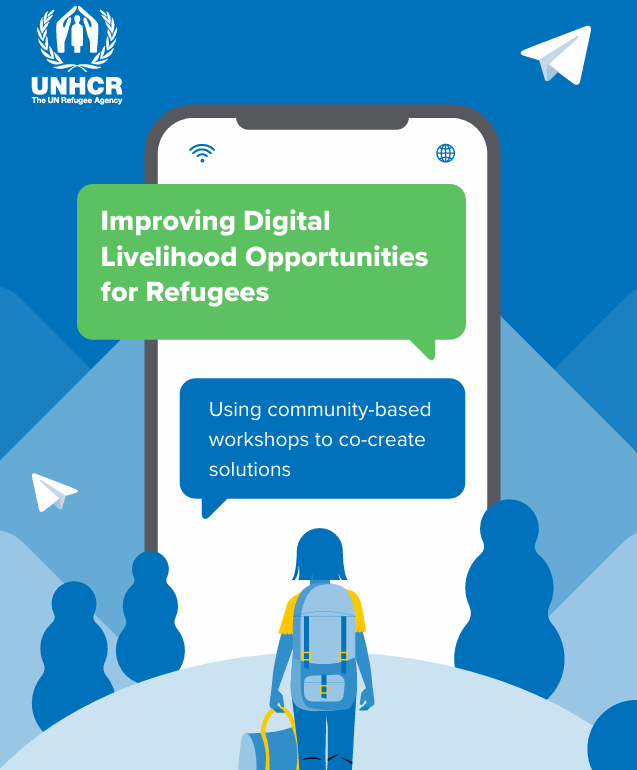
Improving Digital Livelihood Opportunities for Refugees. Using community-based workshops to co-create solutions. The authors, Tyler Tappendorf, Kristin Will, Nada Jaffal and Hicham Jadaoun, would like to thank UNHCR Innovation Services and 17 Triggers for the opportunity to undertake the community-based workshops and analysis for this report. From UNHCR, the team is grateful to Amy Fallon, Solji Oh, John Warnes, Tayná Martins Morais, Jenny Casswell, and Karim Bin-Humam for their engagement throughout the project, including conceptualizing the research topic, reviewing the methodology, liaising with internal stakeholders and reviewing reports. Likewise, thanks go to UNHCR teams in each country for their collaboration in planning for workshops, recruiting participants and reviewing pre- and post-research reports. From 17 Triggers, the team would like to thank Lillian Diaz, Jieun Lee and Imara Roychowdhury for their reviews. The team likewise owes a debt of gratitude to the broader network of consultants who assisted in the seven countries in this project. The report was designed by Amy Novella. Finally, we are grateful to the 541 refugees and host community members who joined the workshops and openly shared their experiences and perspectives on digital livelihoods.
DISC stands for Digital Skills for Integration and Active Citizenship and it is a three-year project co-funded by the Erasmus+ programme of the European Union carried out by 5 partners from Finland, Italy, Spain, Belgium and Slovenia. In today’s Europe, information and communication technologies (ICT) have become the primary source of information about political, social, cultural, academic, and many other affairs and provide access to multiple public and private services. In this context, digital skills are crucial for being an active member of society, and they are also needed for involvement in virtual communities and social interactions. Data from the EU countries show that newly arrived immigrants and their offspring are often poorly involved in communities, less successful in standard education and suffer from exclusion and isolation mostly because of their lower social, economic, and cultural capital and language difficulties. With a fast-growing immigrant population in Europe, there is a strong need for tools that support immigrants’ integration process and prevent exclusion.

Includ-EU aims to contribute to building more inclusive and cohesive European societies by enhancing transnational knowledge and experience sharing, cooperation and partnerships between local and regional authorities from Greece, Italy, the Netherlands, Romania, Slovenia and Spain. The project will improve knowledge and capacities to facilitate the integration of third country nationals; implement and assess pilot projects that promote the integration of TCNs at regional and local level; set an informal network of regions and local authorities with different levels of expertise, that capitalises on the diversity of territorial approaches, policy and practice on integration.
Strengthening SOCIAL COHESION Conceptual framing and programming implications. Strengthening social cohesion has become an imperative of the 21st century. As we move into the 2020s, widespread concern exists about worsening conditions of conflict that threaten respect for diversity, inclusivity and fundamental human rights.1 A sharpening of identity-based tensions, such as ethnic and religious enmity, xenophobia, and resurgent, exclusive nationalism, underlie these conflicts. In April 2019, United Nations (UN) Secretary-General António Guterres decried this “disturbing groundswell” of strife accelerated, in part, by hate speech and leading to intolerance and violence. The Strategy Plan of Action Against Hate Speech is part of overall UN efforts to address the underlying root causes of conflicts that lead to violence and impede realisation of human rights and development. The UN is responding at various levels to the ways in which identity-based distrust and enmity threaten to increase vulnerability to violent conflict. Such efforts are organised today around the United Nations Sustainable Development Goal 16 (SDG16) to create more peaceful, just, and inclusive societies. Strengthening social cohesion between citizens and the state, as well as within and across individuals and social groups, is central to SDG16.6 It targets responsive and inclusive institutions and representative decision-making, thus speaking directly to the need to strengthen social cohesion. Securing legal identity for all persons, reducing bribery, corruption, and state capture, building capacity to prevent crime, and preventing violent extremism all contribute significantly to strengthening social cohesion.